


Baltic knowledge transfer experts discussed bringing research into business at a conference led by Tallinn University
How can knowledge generated at universities be put to use by businesses and society, and how is artificial intelligence changing this work? These questions were at the heart of the Baltic Technology Transfer Network Annual Conference, held in Tallinn on 9 October, which brought together approximately 70 participants from the Baltic states and elsewhere in Europe. Kadri Aua, Legal Counsel for Business Partnership at Tallinn University’s Business Collaboration and Partnerships Centre EXU, led the event, which combined international experience, practical knowledge-transfer issues, and opportunities to build new connections.
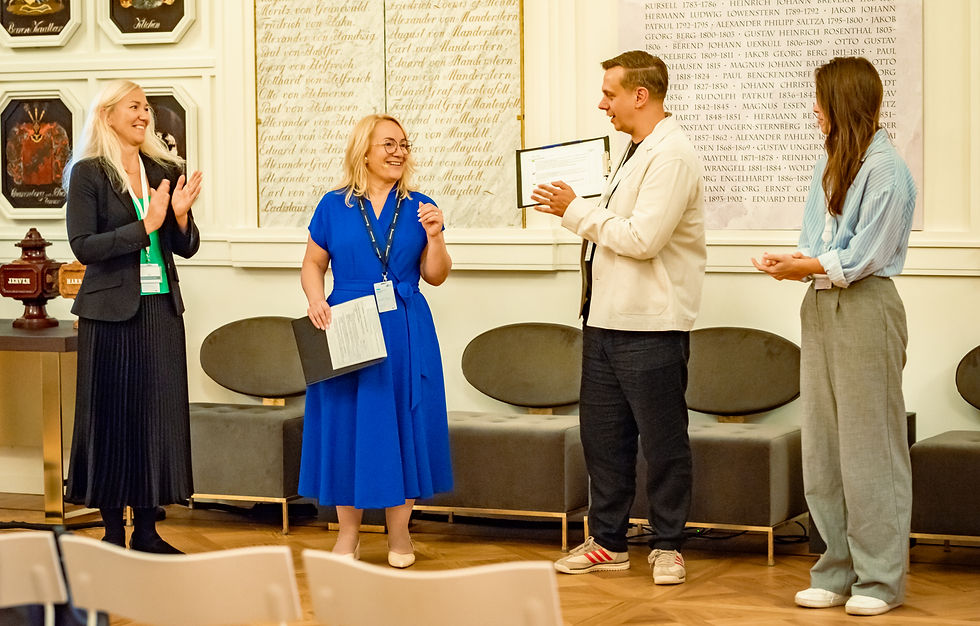
Held at the Estonian Statehood House on Toompea, the conference, “Navigating the Next Era of Knowledge Transfer: AI, Commercialisation and Beyond”, focused on the opportunities and risks of artificial intelligence, the organisation of knowledge transfer offices, the commercialisation of research results, support for establishing and running successful university spin-offs, and intellectual property strategies and management. Alongside colleagues from Estonia, Latvia and Lithuania, speakers and moderators from the Netherlands, Germany, Finland and Norway shared their experience.

Knowledge transfer professionals help researchers and businesses find common ground and turn research results into practical applications. The conference provided an opportunity to compare how universities approach these tasks and learn from colleagues’ experience.
“We wanted to organise a meeting where experienced knowledge transfer experts could speak openly about what has worked well in their practice, what has not, and what they have learned. It was also important to us to create an atmosphere where people felt comfortable speaking freely, exchanging ideas, and making new connections. The conference had a real sense of friendliness and openness: people actively engaged in discussions that continued enthusiastically during breaks. The appreciative and encouraging feedback from both participants and speakers has been particularly rewarding,” says Kadri Aua, the conference’s lead organiser.
Aua co-hosted the conference with Sven Idarand, Head of Knowledge Transfer at the Estonian Academy of Arts. Participants were welcomed by Janne Andresoo, Director General of the Estonian Patent Office, and Erik Puura, Vice-Rector for Entrepreneurship at TalTech.
Artificial intelligence and the path from research to market
The keynote address was delivered by Risto Uuk, Head of European Policy and Research at the Future of Life Institute, PhD researcher and co-founder of AI Safety Lab at KU Leuven. His presentation explored knowledge transfer in the age of AI: the opportunities, risks and strategic choices facing universities.
The topic continued in a panel discussion examining AI in the day-to-day work of knowledge transfer offices. Moderated by Renato Calzone, Head of the Knowledge Transfer Office at Eindhoven University of Technology, the panel brought together Risto Uuk, Dr Florian Kirschenhofer, Senior Startup and Equity Manager at Max Planck Innovation, Rene Väli, AI Expert at AIRE, and Tea Park, Attorney-at-Law at Walless.
Calzone also delivered a separate presentation on strategic choices for knowledge transfer offices and bringing research results to market. He shared practical lessons drawn from his experience leading a university knowledge transfer office.
The discussion also focused on the Baltic experience of establishing and running successful university spin-offs. Moderated by Anu Honkalinna, Head of Spinoff Asset Management at Aalto University, the panel featured René Jõeleht, Head of Technology Transfer Team at TalTech; Kaija Kurme-Jansone, Commercialisation Advisor / Senior Expert – Innovations at the Institute of Solid State Physics, University of Latvia; and Greta Žėkienė, Head of Intellectual Property Management at Kaunas University of Technology.
Universities in the Baltic states face similar questions when developing research-based entrepreneurship, although their approaches and support systems may differ. The network provides opportunities to continue sharing these experiences beyond the conference.
From complex rules to practical decisions
Dr Florian Kirschenhofer’s presentation focused on state aid rules and the challenges they pose in knowledge transfer. The topic concerns how universities structure collaborations with businesses and account for conditions attached to public funding when putting research results to use.
In the practical part of the day, participants worked through strategic intellectual property decisions themselves. Led by Magnus Hakvåg, CEO of the Norwegian company House of Knowledge, the university edition of the “IP Strategy Serious Game” enabled participants to analyse situations, exchange experiences and practise making informed decisions at the intersection of research and business.
The topics addressed at the conference are directly relevant to Tallinn University’s day-to-day business collaboration activities. How can the potential applications of research results be assessed? Under what conditions can a university allow businesses to use its intellectual property? How can researchers be supported in starting a business? And how can public funds be used for these purposes while complying with state aid rules? These are practical questions for which other universities’ experience can be particularly valuable.
The conference received very positive feedback from participants and speakers. They highlighted the practical programme, the high calibre of the speakers, the quality of the organisation, the opportunity to exchange experiences with colleagues, and the open, friendly atmosphere. Participants remained actively engaged until the end of the day in the concluding intellectual property strategy game, discussing different solutions and sharing their experiences.
The network’s value grows between meetings
The Baltic Technology Transfer Network is still young. The World Intellectual Property Organisation (WIPO) initiated its formation and helped to establish a network connecting knowledge transfer professionals at universities in Estonia, Latvia and Lithuania a few years ago. The first conference took place in Vilnius in 2025, followed by this year’s meeting in Tallinn, with Latvia envisaged as the location for next year’s gathering.
One of the Tallinn meeting's central themes was building trust among researchers and knowledge transfer professionals, between universities and businesses, and among colleagues.
Organising the conference enabled Tallinn University to both learn from international experience and contribute to the development of the Baltic Technology Transfer Network. Designing the programme, engaging international experts, and hosting the event helped strengthen relationships with Baltic colleagues and knowledge-transfer experts across Europe. These contacts and other universities' experience are also valuable for developing Tallinn University’s own knowledge transfer and business collaboration activities.
“We do not have to come up with every solution ourselves. If another university has already worked through a similar question, we can learn from its experience. And, of course, it is good when our experience can help others. Knowledge transfer involves a wide range of questions, some of them quite complex. Knowing whom to turn to, and whose experience to trust, has real value. These relationships also help us provide better support to Tallinn University’s researchers and business partners,” Aua explains.

The organisers hope that collaboration among members of the Baltic Technology Transfer Network will extend beyond annual conferences. Regular exchanges of experience and direct contact with colleagues help resolve practical questions more quickly and strengthen collaboration among knowledge transfer professionals across the Baltic states. “What matters is having more colleagues we feel comfortable turning to when we need advice, a different perspective or someone who understands our work,” says Aua, outlining the network’s ambition.
View the full event gallery.
The conference was organised by the Estonian Technology and Knowledge Transfer Network, whose members are Tallinn University, TalTech, the Estonian Academy of Arts, the University of Tartu, the Estonian Academy of Music and Theatre, and the Estonian University of Life Sciences. The event was supported by the Estonian Patent Office, Enterprise Estonia and the Estonian Research Council, and co-funded by the European Union.


Comments